Mobility, Transport & Logistics
The high demands of the automotive industry can only be met if you understand the norms and requirements of those applications. If you do so, there are endless possibilities for 3D-printing in this exciting industry. Curious? See for yourself.
ISO-certified Light & Heat resistant colors
Washable & scratch resistant surfaces
NEWS & STORIES
DYEMANSION, EOS & GRENZEBACH SUCCESFULLY IMPLEMENTED FIRST EVER AUTOMATED AM PRODUCTION LINE FOR POLYMER PARTS AT SCALE AT BMW GROUP
DyeMansion launches Powerfuse S PP vapor polishing solution at Formnext 2022
How 3D-printing changes the way we manufacture products – DyeMansion
Daimler Buses Relies on DyeMansion for Color & Texture Quality in 3D Printed Spare Parts
DYEMANSION, EOS & GRENZEBACH REALISIEREN ERFOLGREICH DIE ERSTE AUTOMATISIERTE 3D-DRUCK-PRODUKTIONSLINIE FÜR KUNSTSTOFFTEILE IN GROSSEM MASSSTAB BEI DER BMW GROUP
DyeMansion präsentiert neue Powershot Performance-Serie für das Post Processing 3D-gedruckter Teile
Dyemansion und Siemens gehen Partnerschaft zur Industrialisierung von AM ein
EU-Innovationsrat wählt DyeMansion für “Green Deal” zur Erfüllung der europäischen Klimaziele aus
STEPPING ON THE GAS WITH THE AUTOMOTIVE INDUSTRY
POLYLINE PROJECT
POLYLINE AT BMW GROUP
DYEMANSION, EOS & GRENZEBACH SUCCESFULLY IMPLEMENTED FIRST EVER AUTOMATED AM PRODUCTION LINE FOR POLYMER PARTS AT SCALE


©DyeMansion
-
Summary
- Background
The POLYLINE project brought together 15 industrial and research partners from Germany to develop a next-generation digitalized production line. This line has been used to produce plastic parts for the automotive industry. The aim was to complement conventional production techniques (e.g. machining, casting, etc.) with Additive Manufacturing (AM) in the form of high-throughput production line systems. The project was funded by the German Federal Ministry of Education and Research with a total of 10.7 Mio. Euro. The project had a defined duration of three years. After the successful completion of the POLYLINE project BMW, DyeMansion, EOS and Grenzebach – four partners of the consortium – draw a very positive balance.
POLYLINE project partners involved: BMW, DyeMansion, EOS, Grenzebach, Krumm e.K., 3yourmind, Optris, Additive Marking, Olschner, Uni Paderborn, Uni Duisburg-Essen, Uni Dortmund, Fraunhofer IGCV, Universität Augsburg, Fraunhofer IML.
Associated partners: WAZP, STIHL, Protiq, GS1 Germany, Oechsler, ZF, Main Incubator, TOPTICA, Prototal, 1zu1.
WHAT THE PROJECT TEAM MEMBERS SAY
“Automation is one of the key drivers in our strategy, making it possible to integrate our systems in automated production lines like POLYLINE. And this is important to reduce cost per part and ensure the right quality throughout the whole production chain.”
“The POLYLINE automated process chain fits into the next generation printers and our standard production requirements, is a system-agnostic solution due to their standardized interfaces. Which is crucial for scaling-up Additive Manufacturing at the BMW Group.”
“The EOS P 500 sets a new standard in terms of industrial Additive Manufacturing. It can be fully automated and fully integrated. The level of automation and integration then differs from the use case and can be adjusted specific to each situation. The machine ensures highest reliability, the highest level of homogeneity, repeatability, and reproducibility.”
“Automation is essential for serial production to increase the productivity of the equipment and to reduce the cost to become more compatible to the conventional production technology of today.”
DRONES & OTHER UNMANNED VEHICLES
CASE STUDY: DRONES & OTHER UNMANNED VEHICLES
Adding value though high-end post-processing for multiple missions of unmanned vehicles.


©DyeMansion
-
Summary
- Background
IMPROVED MECHANICAL PROPERTIES
- Increased strength & durability: Processes like VaporFuse Smoothing seal porous surfaces, making parts more impact-resistant and weatherproof.
- Fatigue resistance: Strengthened parts extend the UAV’s lifespan, reducing maintenance and replacement costs.
CUSTOMIZATION & BRANDING
- Vibrant & UV-stabilized Colors: DyeMansion’s DeepDye Coloring allows drones to be customized in various tactical, industrial, or brand-specific colors, optionally with increased light & heat fastness. Make your drone visible or invisible by adding specific colors.
SURFACE FINISH & AERODYNAMICS
- Reduced drag: Smoother surfaces reduce air resistance, improving improving flight efficiency, battery life and movement stability. Professional look: A high-quality, injectionmolded appearance makes drones more attractive for commercial and military applications.
CHEMICAL & ENVIRONMENTAL RESISTANCE
- Weatherproofing: Post-processed parts are more resistant to light exposure, humidity, and extreme temperatures, ensuring longer operational lifespans. Chemical resistance: Protection against fuel, lubricants, and harsh cleaning agents used in industrial applications.
WEIGHT OPTIMIZATION
- No need for heavy coatings: DeepDye Coloring does not add any extra weight, helping UAVs maintain an optimal power-to-weight ratio.
- 3D-printing enables the production of ultra-light and yet fragile drone parts: VaporFuse Surfacing significantly improves their resilience and durability.
Powder-based polymer 3D printing enables extremely lightweight, highly complex, and aerodynamically optimized structures that are impossible to manufacture with traditional methods. It allows multiple components to be consolidated into a single printed part, reducing weight, assembly time, and potential failure points. The materials used offer strong mechanical performance, temperature resistance, and durability against vibration, moisture, and harsh operational environments—ideal for UAVs, drones, and unmanned maritime systems. Fast iteration without tooling accelerates development cycles and enables rapid prototyping as well as functional final parts. On-demand production and digital spare-part strategies ensure flexibility, customization, and quick field repairs. Powder-based processes also provide high accuracy and consistent surface quality, improving aerodynamic and hydrodynamic efficiency. All of this increases the demand for highly advanced post-processing to elevate these parts to peak functional and aesthetic performance.
SPARE PARTS
Case study: Daimler Buses
Disrupting the supply chain with a sustainable on-demand production


©DyeMansion, Daimler Buses, EOS
-
Challenge
-
Solution
- Result
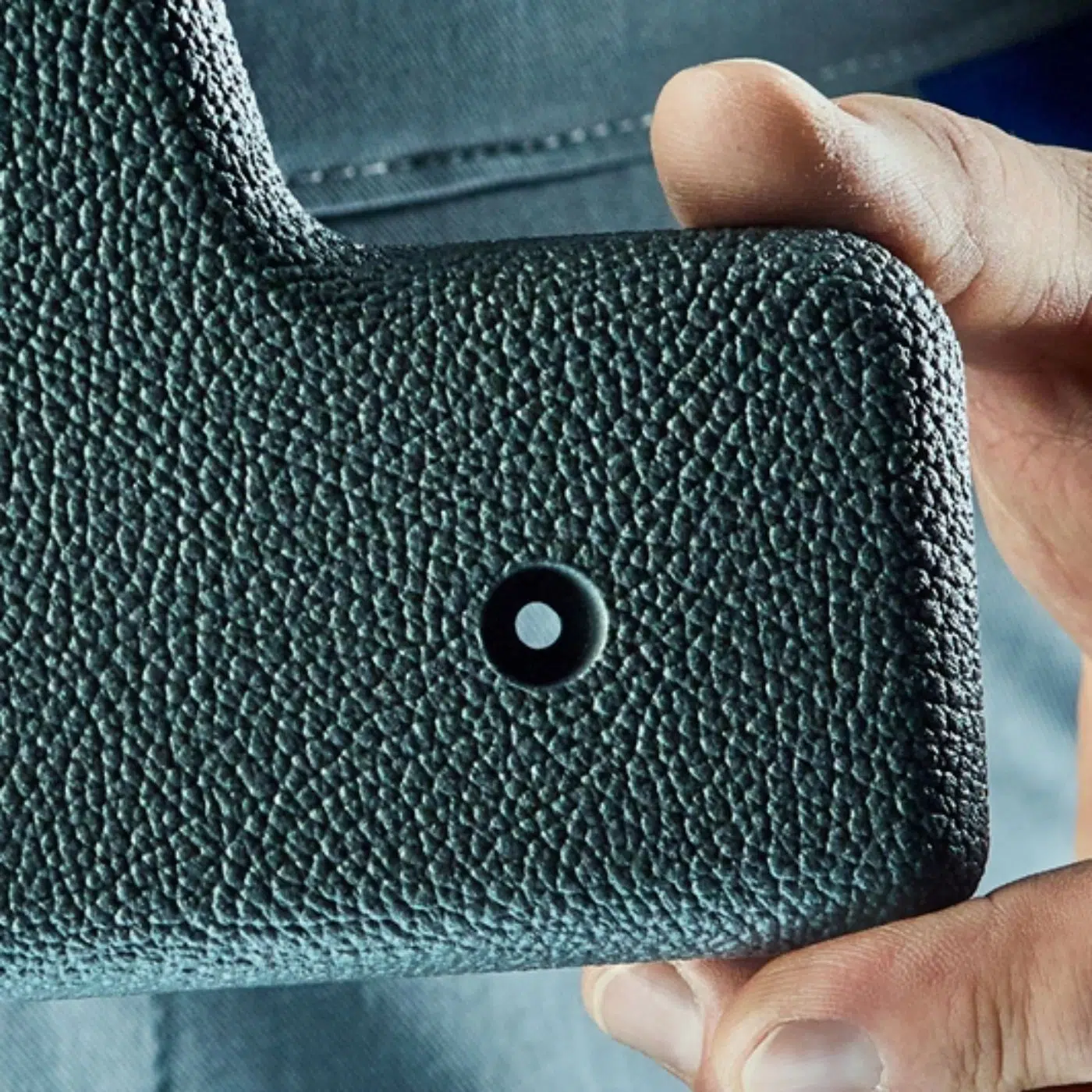
The global player Daimler already had some experience in Additive Manufacturing and was looking for a way to revolutionize their supply chain for spare parts. A spare part must replicate the original injection molded part as good as possible. It was obvious, that the 3D-printed parts were going to need several stages of post-processing to match the look & feel of the original injection molded part.
A reproducible and traceable process that meets the highest quality requirements. After consultations, the premium automotive manufacturer found a solution with the DyeMansion Print-to-Product workflow, consisting of the blasting systems Powershot C and Powershot S and the DM60, that delivers color to white polyamide parts. The Powershot S achieved a premium finish and kept the textures of the spare parts.
The process does not affect the part structure or geometry, saves the Leather-like surface structure of the parts as well as meets the technical specifications and surface quality standards. In a nutshell:
- on-demand production
- customized corporate Daimler colors
- texture preservation to meet the look and feel of the original injection molded parts
- reproducible & traceable processes
POLYSHOT CLEANING
POLYSHOT SURFACING
DEEPDYE COLORING
“We can now produce spare parts at scale using on-demand 3D-printing and finishing processes that meet our technical specifications and surface quality standards.”
AUTOMOTIVE
Case study: Ford Mustang
3D-printed pony sculpture to all Mustang Mach-E First Edition buyers


©Ford
-
Challenge
-
Solution
- Result
When thinking Additive Manufacturing, you think of making parts, assembly fixtures or jigs to help build a vehicle. But this is another place where Additive Manufacturing can shine and showcases its potential to personalize.
The 3D-printed sculpture is made at the Ford Advanced Manufacturing Center and comes in one of three colors, just like the Mach-E First Edition. Printed in white, it’s then sent to a dye facility to be finished in the custom colors Rapid Red Metallic, Grabber Blue Metallic, or Carbonized Gray to match the vehicle it’s handed out with.
Benefits:Â
- customized Mach-E First Edition colors
- personalized 3D-printed sculptures
POLYSHOT CLEANING
PolyShot Surfacing
DEEPDYE COLORING
AUTOMOTIVE
Case study: Stratasys Direct Manufacturing x NASCAR
SAFâ„¢ air flow ducts manufactured for NASCAR Next Gen cars


©DyeMansion, Stratasys Direct Manufacturing
-
Challenge
-
Solution
- Result
For the 2022 racing season, NASCAR was looking for a way to cool their drivers inside the cockpit of their vehicles. These parts had to fit perfectly into the windshields, meet all safety and performance criteria as well as be aesthetically pleasing due to their high visibility in the cars.
NASCAR worked closely together with their competition partner and our Production Partner, Stratasys Direct Manufacturing, to create these production parts and get them ready for the racetrack in only a short amount of time. The SAF parts were printed by Stratasys Direct on the Stratasys H350 printer and finished with the DyeMansion Print-to-Product Workflow.
Stratasys Direct Manufacturing was able to deliver finished parts (250 units) on a very short timeline (44 days), while meeting all performance and safety standards. The success of the parts during the 2022 season prove that 3D-printed components are sure to have a lasting impact in NASCAR and the motorsport world.
POLYSHOT CLEANING
DEEPDYE COLORING
POLYSHOT SURFACING
AUTOMOTIVE
Automotive BlacKX
A light and heat resistant color for car interior parts
-
Challenge
-
Solution
- Result
Especially in the automotive sector, reproducibility and improved color fastness are particularly important. If 3D-printed parts are in operation in the interior of cars, they must withstand numerous external influences. The resistance to heat and light, good scratch resistance and good color fastness regarding both distortion and bleeding are particularly worth mentioning here.
To meet these demands, we developed a special color range within the extended ColorsX series, which is characterized by significantly improved light and heat resistance.
The strict criteria of the automotive industry can be met for the first time with this new color. Furthermore, any other color can be developed by automotive brands directly on request via our Color Matching offer.